Lenny’s job report. Code layers. Agents.
What’s New
State of the tech job market: late 2026
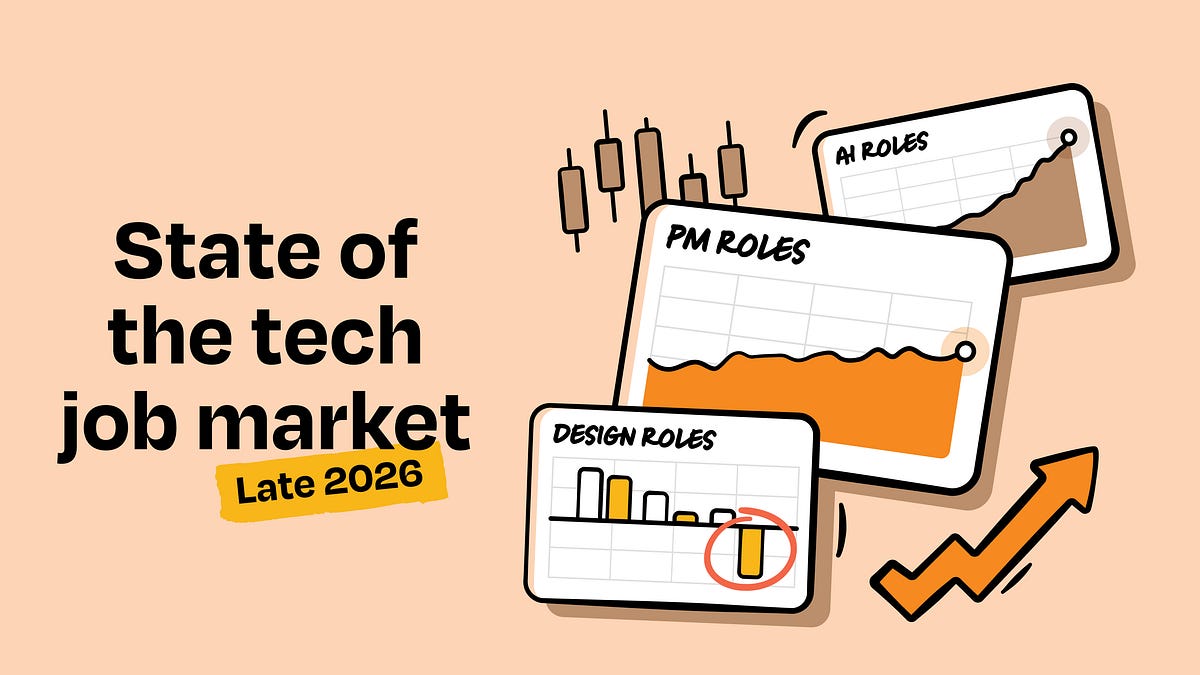
Lenny Rachitsky’s latest job market report has the worst numbers yet for designers. There are about 1,900 open product design roles at tech companies globally, down 28% from a year ago and the lowest since he started tracking. There are now 3.8 open PM roles for every open design role. Then the twist: “For designers, Figma has been mogging every other skill for years. And narrative violation: demand for experience with Figma has actually grown over the past three years.” Claude is now the second most mentioned skill in designer job descriptions, ahead of CSS.
Nick Pattison – The $50,000 Brand Design Sprint
In Jayneil Dalal’s Sneak Peek interview, Nick Pattison walks through a real sprint, from a pre-made mood board to two brand directions, color zones, and type, including a concept that started from AI before it went somewhere AI wouldn’t. His reasoning for a single price and timeline: “clarity is paramount in creating a container for creative work.”

Interface Lineage
Johannes Mutter spent 15+ years collecting the interfaces that made him ask “wait, how does this work?” Interface Lineage is now a free library of 500+ of them, traced back to their origins: Pull-to-Refresh building on inertial scrolling, the iPod wheel coming from a Bang & Olufsen cordless phone. Its premise is “You can’t prompt what you can’t name.”

The Designer's Guide to the Buttons
A book by Andrew Marcus about interface design from the Xerox Alto to the Apple Vision Pro, with one chapter per component: buttons, checkboxes, text fields, menus, dropdowns, down to their anatomy and states. It has about 500 illustrations drawn from 180 well-known apps. It’s also a practical guide to building a design system.
Code Layers
The canvas in Figma is getting a whole lot smarter
Code layers and Specs are now available to everyone. Brett McMillin, Designer Advocate at Figma, shows how the two fit together over 13 minutes. He gathers context in a spec, prototypes the feature in a code layer, refines the interaction states, and hands off with a technical plan. His framing is that the canvas is becoming “more of a living workspace.”

Toto, we're back on canvas.
Code layers are out to everyone, and Nikolas Klein, PM at Figma, tells the story behind them. It started at a summer 2024 Maker Week, where a few of them tried generating code from Dev Mode annotations (“And holy moly it worked.”), and went through Sites, Make, and Make embeds before landing in Figma Design. Then the landscape shifted: designers started working with real codebases, so code layers learned to import local folders, clone GitHub repos, and open PRs back.

Export shaders at higher resolutions and bring them into code layers
Shaders can now render and export at 4K and go straight into code layers. The second part matters more: shaders stop being a static export and become part of the interactive prototype.
Figma Design
Select objects even faster with Figma's AI image editing tools
Click an object in an image and Figma selects it, ready to isolate or erase. It’s a small change to the Select area tool, but it removes the most tedious part of image cleanup. Only on the macOS desktop app.
Improvements to agent-generated vector illustrations and icons
Miggi shows off the Figma agent’s new vector skills. It creates alternate arrows from a style reference, then applies a path trim with a color-cycle animation. Per the release notes, the agent’s vector illustrations and icons are now easy to edit, match to your style, and animate.

Figma Motion
Shaders and Motion with the Figma agent
Brett McMillin, Designer Advocate at Figma, uses the agent to automate motion, generate a custom shader, stack built-in and custom effects, and end on real-time light refraction through glass.

Figma Motion on Editions
For Shopify Editions Fall 2026, the team shipped nearly 20 product animations on one page as plain HTML and CSS exported from Figma Motion. Arnaud Tanielian explains how they built a compiler plugin that turns Motion timelines into CSS keyframes, with real text in six locales and no runtime. Compared with the same story in Rive, it was ready to play 38% sooner and the page downloaded 33% less. They’re honest about the limits: DOM size, higher CPU use, and no state machine.

Figma Weave
Figma Weave designed this whole page
A good example of Weave as an asset pipeline. One canvas produces a set of consistent visuals (four seasons of the same frame, depth maps, motion studies), and Claude Code turns them into a page. Meng To shared both the prompt and the workflow.

Figma Updates
You can now add your designs to your Community profile as riffs
Figma Community continues its slow move toward Dribbble territory. Riffs can now live on your Community profile as a portfolio, and the Inspo feed collects them into a stream of work to browse.

Connect Google Drive to the Figma agent, available on all plans
The Figma agent and Make can now read your Google Drive. You can pull in Docs, Sheets, and Slides, summarize what’s in them, and create new files from Figma. It’s available on all plans, which is notable for an agent integration.
AI
How we're training a Figma-fluent editing model
“We’ve increasingly seen that specialized post-training can compete with frontier models.” Figma explains the model behind the agent’s everyday edits. It started with supervised fine-tuning on synthetic edit requests in Figma’s native file format, and an early Llama 3.3 70B trained on more than 250,000 examples was competitive with the top models of the time. The agent now routes the work. Third-party models handle image generation, vectors, and new explorations, while Figma’s own model handles precise edits and iterations.
“I find Figma's AI approach super interesting”
Amichai Mantinband, co-founder and CEO of Brilliant, read Figma’s model post and lays out where it’s smart and where it might break. Small fine-tuned models are much cheaper and keep getting better, but “Fine tuning teaches taste and figma’s data model, HOWEVER — it does not add intelligence.” Design data is verbose, and real projects have hundreds of components. His conclusion is a trade-off between a frontier model that “can’t speak figma” and a small model that can’t reason past a certain level of complexity.

Inspect by Ramp
Ramp’s background coding agent is now available to other teams in early access. Every session is multiplayer by default, and every PR comes with visual proof: screenshots and live previews for frontend work. For designers, the takeaway is in the usage data, since 99% of Ramp’s engineering, design, and product teams used it in the past month.
Proto
“I was shocked that 3/4s of designers work in coding agents rather than design tools.” Maayan Albert, formerly at Browserbase, Apple, and Google, is building Proto, “the designer’s IDE”: the shape of Claude Code and Cursor, “but with every design feature you wish they’d ship.” It’s in early access.

Design Systems
Is Your Design System AI Ready?
What does an AI-ready design system look like in practice? Kaelig Deloumeau-Prigent walks Brad Frost through his updated State of AI in Design Systems report (first covered in #258) and singles out Meta’s Astryx for running nightly evals to check that its skills produce good outcomes. Then they run the audit on Eddie. Brad’s takeaway: the tooling surfaces the gaps, and people still have to decide what matters.

How Reddit's designers build ultra-realistic prototypes with Figma + Cursor
Blair Metcalf, principal UX engineer at Reddit, demos Reddit Proto on How I AI. It’s an in-house prototyping harness built on the design system, used by 100% of Reddit’s UX and product org, with about 700 prototypes live. The clever part is real data. Prototypes can render a signed-in user’s actual feed, because leadership dismisses mocked screens with “This isn’t relevant to me.”

[css-forms-1] Cursors for base appearance
The CSS Working Group resolved to give buttons, selects, checkboxes, and radios cursor: pointer in the new appearance: base form controls. The decision is partly based on Nicole Sullivan’s analysis of design systems: “27 of the 33 systems that specify a cursor use pointer.” The old “pointer is for links” debate is back in the comments, and both sides make good points.
Plugins
Design Recap
“Designers don’t need help designing, they need help with everything around it.” Jaycee Day’s plugin analyzes your Figma files and writes up what you’ve worked on recently, plus a changelog, for weekly reports, standups, and developers who want to see what changed. She built it after talking with 40+ designers, and in a follow-up post she describes how their workflow shifted: “designers are exploring in Claude, iterating in Figma, then bringing it back to Claude to finish building.”
Resources
IconMCP is now open to contributions, from you or your agent
IconMCP is a free, MIT-licensed set of 6,248 icons with an MCP server your coding agent can search by meaning. Dash, of UI8, opened it to contributions. Agents can request a missing icon, report one that’s off, or draw a better version. A judge compares each fix blind against the current icon, and the better one ships, credited to the agent that drew it.

I designed all of these landing pages in the last two months
Elaya, a product designer, designed a series of landing pages with Higgsfield, Claude, and Cursor, then open-sourced the skills behind them. landing-page-design covers intake questions, structure, conversion copy, and a full visual system. figma-designer builds in Figma with variables, text styles, auto layout, and components with every state.

Backstage
Ezra Mechaber – The AI chief of staff that this Figma PM uses all day
Ezra Mechaber, growth PM at Figma, shows Claire Vo the PM OS he and a few fellow PMs built. It’s a shared repo of 31 skills that every PM at Figma uses, kept in sync across 60 to 70 PMs, with private sub-repos for each person’s workspace. The standouts on How I AI: a “what’s up” skill he runs six times a day to tame Slack, bug bashes run by an agent in the browser, and AutoXP, an automated growth loop that found a huge win on its first experiment.

Figma Announces Third Quarter 2026 Financial Results
Revenue grew 43% year over year to $391.4M, $16.4M above the top of guidance, and Figma raised its full-year outlook to about $1.5B. Net dollar retention was 131%, down from 136% in Q2 (#258). Dylan Field’s framing: “As code becomes a commodity, value is moving up the stack to design.”
Cool Thing
Tomjohnville
Tom Johnson rebuilt his portfolio as a tiny town you can walk around, drive a truck through, and explore with others in real-time multiplayer, with NPCs that talk back. Then he published how it was made, phase by phase, with the prompts, tokens, and diffs behind each one. His perf story is my favorite: “I had agents running overnight every night for about a week to try to get to 60fps.”