
#MCP
How SpaceXAI designers use Grok Bot and Figma MCP to ship faster
Peng Zheng’s personal site updates itself, as he shows host Claire Vo on How I AI. Send his check-in bot a photo, a screenshot or just the name of a place, and it looks the place up through the Google Places API, fixes the perspective, removes people and generates light and dark 3D miniature versions for the site.
Figma MCP: Run Weave tools, right from your favorite agent
Weave is now callable from ChatGPT, Claude, or Cursor. Ask the agent to run the brand mockup tool you built in Weave, and it finds it, runs it, and returns the result in chat.
The Reach and the Recipe
“MCP gives your AI reach. Skills give it a recipe.” Murphy Trueman compresses two acronyms into one sentence you can actually hold onto. MCP is access: Claude reading your real Figma file, walking every fill on a button set and finding the fourteen layers still on raw hex, all of them on hover and disabled states. A skill is the playbook it follows once it’s in there. Their rule for writing one is the third time you catch yourself explaining the same preference, write it down.
New in the Figma MCP server: Slides, uploaded fonts, and more
Four updates to the Figma MCP server: Slides support so agents can create and update presentations from your templates, local uploaded font rendering instead of web-safe approximations, a new download_assets tool for exporting JPG, SVG, and PDF files directly out of a Figma file, and Xcode compatibility for bringing mobile designs into Xcode to preview screens.
4 ways we're using our MCP server at Figma
Mari Kong rounds up four real workflows Figmates are running with the MCP server now that it spans Slides, FigJam, Make, and the Figma agent. Mallory Dean refreshes her AI product launch deck from Slack and Google Drive with one prompt. Prasant Lokinendi generates FigJam kickoff boards from live Asana, Notion, and Hex data. Iris Lin moves designs bidirectionally between canvas and code, ending in a GitHub PR. Yarden Katz drops a code-only screen into Figma, maps it to real components, fixes it with the Figma agent, then pushes it back. None of these are demo scenarios — they’re the actual recurring work.
Figma MCP Server in Xcode
Figma’s official announcement that the Dev Mode MCP Server now plugs into Xcode, alongside Cursor, VS Code, and Claude Code. The practical win, as one designer put it in the replies, is that design tokens stop getting copy-pasted into Swift and component states stop being decoded over Slack — the Figma file becomes the thing Xcode actually reads from.
Getting started with custom Figma MCP skills
A skill is just a markdown file with strict instructions, optionally pointing to scripts the agent can run. Amy Lima and TJ Pitre build one live that round-trips a localhost prototype back into Figma via the use_figma tool, with per-state annotations for engineers and PMs who can’t comfortably leave feedback on a running prototype. They also cover the contribution flow to Figma’s community skills page. A good entry point if you’ve been wondering what the “skills ecosystem” around Figma’s MCP actually means in practice.
Workflow Lab: Expanding the Canvas with Figma MCP
Brett McMillin shows a concrete loop: an agent reads a coded export flow, finds every state the developer shipped (success, error, loading, edge cases), and generates fourteen designable frames on the canvas using the design system. From there, the designer riffs on three animation directions, the /sync-figma-token skill flags token drift between code and variables, and a generate_figma_design call produces an annotated side-by-side diff.
The TL;DR on MCP: Why Context Matters and How to Put It to Work
Emma Webster’s overview of why MCP exists and what it changes. Without context, AI coding tools work from a screenshot — they see the end result, not the decisions that went into it. The Figma MCP server hands agents structured access to components, tokens, and layout decisions instead. Useful as the conceptual baseline before getting into the applied workflows in the lab.
What the Design-to-Code Loop Unlocks
A conversation between Figma’s Design Director of AI Gui Seiz and engineer Alex Kern on how AI inverts the old economics, code used to be expensive and design cheap, now both are cheap and the bottleneck moves to intent. The companion piece to the two MCP posts and the Code to Canvas tutorial elsewhere in this section.
Figma tutorial: Code to canvas with your design system
“AI designs with you, not instead of you.” Figma’s positioning for useFigma, the new write-capable MCP tool that creates real components, variables, and auto layout on the canvas, not flat images or wireframes. The demo runs the full loop: terminal prompt to first draft, manual polish in Figma, annotations the agent later reads as design context, then back to the terminal to update the codebase. The annotations detail is the most interesting part — they double as machine-readable spec.

Getting started with the Figma MCP server
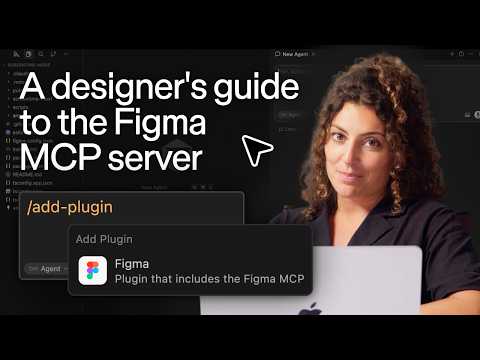
Designer advocate Amy Lima walks through a full code-to-canvas-to-code round trip on a sample app: install the MCP in Cursor with /add-plugin, authenticate via OAuth, generate a new screen iteration into Figma, refine it by hand, then prompt the agent to update the codebase and open a PR. Pairs well with the useFigma deep dive below.
Release Notes 2026 — May Edition
The May edition is mostly a demo of Figma’s MCP server, with Amy Lima and Anthony DiSpezio walking through three workflows: code-to-canvas import of a vibe-coded prototype, round-tripping a dark mode so variables stay in sync between code and Figma, and using the pre-installed figma-use-scale skill to generate first-pass directions on a production dashboard. The closing update reel includes vector editing up to 10x faster, memory warnings down 92%, macOS eyedropper now samples anywhere on screen, FigJam MCP can read and write boards (ERDs, architecture diagrams), Make Kit packages your design system’s code for Figma Make, and Weave gets a timeline for video.

Figma Console MCP – Turn your design system into a living API
TJ Pitre’s Figma Console MCP is the most ambitious MCP server for Figma I’ve seen — 94+ tools spanning design-system extraction, file and FigJam and Slides creation, plugin debugging, and full-spectrum WCAG accessibility scanning across both design and code, including 13 design-side lint rules and code-side scanning via axe-core. Pair this with TJ’s Claude Design piece in the section above — it’s the same author making the case for what design-systems-aware AI tooling actually looks like.
The MCP Tool That’s Changing How I Use Figma
Joey Banks: “…trying Figma Console MCP has completely opened my eyes into what I can offload. Not because it replaces the enjoyable work that I was doing before, but because it handled some of the longer, more repetitive tasks so quickly, and actually so well. Creating 200+ variables took seconds, and mapping them to color swatch instances so the team could preview values was way easier than I expected.”
Figma Live: Figma MCP x OpenAI Codex
“Join us to hear how Figma and OpenAI’s Codex are making design-to-code workflows more efficient and accurate. With the Figma MCP server, developers can easily bring design context into Codex to generate production-ready code. We’ll chat with Romain Huet, Head of Developer Experience at OpenAI, for a live demo, practical tips, and a Q&A session.”

Code with Context using Figma MCP Server
Developer Advocate Akbar Mirza joins VS Code Live to discuss how the remote Figma MCP server and new Code Connect updates bring design and codebase context into VS Code, so you can generate production-ready code that is aligned with your design system.
New drop for the MCP server
The official Figma MCP server now supports Gemini CLI, OpenAI Codex, and Atlassian is coming soon.
New drop: The official Figma MCP server now supports @googledevs Gemini CLI and @OpenAI Codex, @Atlassian coming soon pic.twitter.com/sCKx6hZWjN
— Figma (@figma) October 8, 2025
Claude Code + Figma
Another demo of using the new MCP server with Claude Code.
Turn design into code with Claude Code + @figma.
— Claude (@claudeai) September 23, 2025
Through MCP, Claude sees your mockup at the data level—component hierarchies, design tokens, auto-layout rules—and translates it into production-ready code. pic.twitter.com/uMWKOfM1DW
Build your ideas with Cursor and Figma
Watch Lee Robinson go from design to code with GPT-5-Codex and Agent.
Build your ideas with Cursor and @Figma.
— Cursor (@cursor_ai) September 23, 2025
Watch @leerob go from design to code with GPT-5-Codex and Agent. pic.twitter.com/VBAjpsthwV