
#Products
Workspace-level web publishing
Web publishing in Sites and Make has been an all-or-nothing setting. Now admins can set an org-wide default and carve out exceptions per workspace, so security-sensitive teams stay locked down without blocking everyone else.
Organize the way you work with new tab groups
Tab Groups brings folder-like organization to the Figma desktop app’s tab bar. You can group tabs by project, theme, or workflow, assign a color to each group, and collapse or expand them to stay focused without losing access to open files. A nice improvement for anyone working across multiple projects.
Three new ways to wire nodes
Three small connection upgrades in Figma Weave: select many nodes and connect them to one in a single move, hold Shift to fan one node out to many, or double-click a handle to spawn a prompt node already wired in.
The first ever Config Makeathon — $100K in prizes
Figma’s first Config-branded Makeathon, co-hosted with Contra, runs June 4–18: build something with Figma Make for a shot at $100K in prizes, including a $50K grand prize. All participants get Figma Pro free for the duration, and the first 10K to pre-register before June 3 unlock early access to Figma’s new design agent beta.
Check Designs: catch what's off, ship what's right
Check Designs scans your file against your design system and flags four categories of drift: hard-coded color, text, radius, and spacing values that should be tokens; color contrast violations below WCAG 2.0 AA or AAA; components sourced from unsubscribed libraries; and fully detached components. Each issue comes with a one-click fix. Unfortunately, it’s only for Organization and Enterprise plans now — a big miss for many teams on Professional.
Sharper controls for every slot
Slots in Figma Design just got a set of guardrails: min/max layer counts, instance restrictions to limit what can go inside a slot, an empty-slot default so slots stay visible on canvas, and auto-fill behavior. Slots are now generally available, and these controls make them genuinely safe to use at scale.
Capture web pages to layers with the Figma Chrome extension
The Figma Chrome extension can now capture any web page or element and bring it into Figma as editable layers — including text, shapes, images, and frames. It’s not a screenshot: the capture lands as actual design objects you can manipulate. Still in beta and limited to paid plans, and worth noting that design system mapping isn’t supported yet — your library components and variables won’t be automatically matched to captured elements.
A product designer's guide to the Figma agent
An official Figma walkthrough of the agent (currently in beta, rolling out since May 20) through three phases of a real design project: exploring directions, processing feedback, and automating repetitive updates. The most practical detail: the agent works with your connected design system from the first prompt, so generated screens use your actual components, variables, and styles rather than placeholders. Also worth trying a prompt like “what would a growth-focused PM say about these designs?” to simulate stakeholder pushback before the actual review.

Plan smarter with more context in Make
Three quality-of-life additions to Figma Make. Plan Mode lets you shape a project before generation starts — Make asks clarifying questions, drafts a plan, and waits for your approval before building. It costs more AI credits than a standard build, but the estimate shows upfront. Web Search & Fetch lets Make pull live content from the web or a specific URL mid-build. And queued messages let you stack follow-up instructions while the current generation is still running.
Figma Make, Now on Your Local Code
Make can now connect to a local repo and edit your real production code, not just a sandboxed project. Designers point at an element, adjust properties or leave an annotation, and the agent finds the relevant code, commits the change, and opens a PR through standard GitHub flow (SSH for other providers). It also handles dependency installs and spins up the dev server for you. Closed beta on the Mac Beta desktop app and beta usage doesn’t burn credits.
Bulk edit in Figma Buzz
Buzz’s spreadsheet-driven asset generation gets the obvious next step: multi-select cells in the table view to edit copy, swap brand imagery, or change sizes across hundreds of variants at once. Resize works on a single asset or the full set, with preset or custom channel sizes to fan out a campaign in one operation.
Sections in Figma Slides
Name slide rows, drag to reorder them, and jump between sections directly from Presenter or Audience View. Sections also show up in the layers panel in Design Mode, which keeps long decks navigable as they grow.
Turning Prompts into Five Scalable Workflows with Figma Weave
Five workflows that show what Figma Weave is actually for: chaining AI nodes on a canvas to blend two references into a style guide, fan out variations across aspect ratios, run eight distortion filters in parallel, generate rotatable 3D models through Rodin 3D V2, and composite stills into rendered video.
7 Tips for Using Figma Make Credits More Efficiently
Alexia Danton, Designer Advocate at Figma, walks through seven tactics for stretching Make credits further. The most useful ones are the least obvious: use the Edit tool and “Go to source” for small visual tweaks instead of prompting, codify repeated instructions into a guidelines.md file so Make doesn’t relearn your conventions every turn, and reach for Gemini Flash on routine iteration while saving Claude Opus for ambiguity and high-fidelity work.
New capabilities coming to Figma Make
The on-camera companion to the Make-on-Local-Code launch. The most interesting bits beyond the blog: a Figma editing panel inside Make for direct style changes, multi-element annotations pinned to the rendered screen (including voice mode), and MCP server support for resolving merge conflicts and CI failures. The pitch is that designers get agency to ship the change themselves while the engineer’s review workflow stays untouched – apple for early access.

We're Gridmaxxing
A few updates to Grids – reorder columns and rows by dragging, automatic positioning, and automatic rows – the last one is my favorite!
Meet the Figma Design Agent
“We don’t think designers should generate a one-shot screen and call it a day.” That sentence from the announcement is Figma’s vision for the design agent in a nutshell. The framing is explicitly co-pilot, not auto-pilot: the agent runs in front of you on the canvas, riffs to spark an idea, and then hands it back to your mouse and direct manipulation. Pair that with native access to your libraries, components, and tokens, and the bet is clear – the winning AI design tool is the one that already knows your design system, not the one that generates the prettiest screenshot.
Rolling out gradually in beta over the coming weeks. During beta, the agent won’t consume credits. See also the official announcement at The Figma design agent is here.

Get started with the Figma agent
A short onboarding walkthrough for the agent beta. Worth watching for the suggested starter prompts: generating alternative layouts, starting from scratch using your design system, working together on canvas, and getting feedback.

Getting started with the Figma MCP server
Designer advocate Amy Lima walks through a full code-to-canvas-to-code round trip on a sample app: install the MCP in Cursor with /add-plugin, authenticate via OAuth, generate a new screen iteration into Figma, refine it by hand, then prompt the agent to update the codebase and open a PR. Pairs well with the useFigma deep dive below.
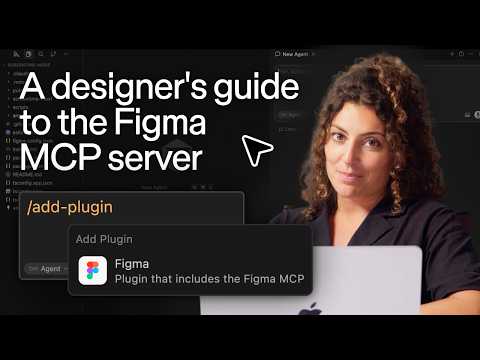
Figma tutorial: Code to canvas with your design system
“AI designs with you, not instead of you.” Figma’s positioning for useFigma, the new write-capable MCP tool that creates real components, variables, and auto layout on the canvas, not flat images or wireframes. The demo runs the full loop: terminal prompt to first draft, manual polish in Figma, annotations the agent later reads as design context, then back to the terminal to update the codebase. The annotations detail is the most interesting part — they double as machine-readable spec.
